
How to Accurately Calculate the Amount of Epoxy Resin for Casting?
When working with epoxy resin, it is crucial to correctly calculate the required amount of material to avoid shortages or unnecessary waste. The calculation depends on the volume of the mold, the density of the epoxy resin, and the mixing ratio of components A and B. In this guide, we will explain how to accurately determine the volume in liters and weight in kilograms for any epoxy system.
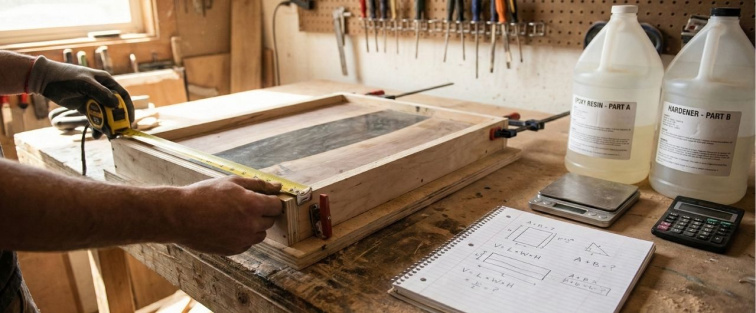
Calculating the Amount of Epoxy Resin
🔹 Calculating the Amount of Epoxy Resin by Volume (in Liters)
The simplest method is determining the volume of the mold. This calculation applies when the epoxy resin is measured by volume – in liters.
📌 Formula for calculating resin volume:
🔹 Volume (liters) = length (m) × width (m) × height (m)
🔹 Example of Volume Calculation in Liters:
If you are casting a tabletop with dimensions 100 cm × 50 cm × 2 cm, first convert the units to meters:
📌 Volume = 1.0 × 0.5 × 0.02 = 0.01 m³
📌 1 m³ = 1000 liters, so:
📌 Resin Volume = 0.01 × 1000 = 10 liters
🔹 When calculating in liters, we use a density of 1.0 g/cm³ (1 kg/l), so 10 liters = approximately 10 kg of resin.
💡 Tip: This calculation is useful for thin surface coatings and an initial estimate of the required amount.
🔹 Calculating the Amount of Epoxy Resin by Weight (in kg)
If the epoxy resin is mixed by weight, you must consider the density of the material, which typically ranges from 1.05 to 1.15 kg/l depending on the specific product.
📌 Formula for calculating resin weight:
🔹 Weight (kg) = volume (liters) × density (kg/l)
🔹 Example of Weight Calculation for Different Epoxy Systems:
We have 10 liters of epoxy resin and need to determine its weight:
📌 Resin with a density of 1.07 kg/l (e.g., LuminaCast) → 10 × 1.07 = 10.7 kg
📌 Resin with a density of 1.05 kg/l (e.g., EpoxyPlast 3D) → 10 × 1.05 = 10.5 kg
💡 Tip: The density is always listed in the technical data sheet of the product, so check before making your calculation.
Calculating the Amount of Components A and B
🔹 Calculating the Amount of Components A and B Based on Mixing Ratio
Most epoxy resins are mixed at a 2:1 or 3:1 ratio (by weight or volume). If you have a weight-based ratio, use the following formula:
📌 Formula for calculating components A and B:
🔹 Component A = total weight × (A ratio / sum of A+B ratio)
🔹 Component B = total weight × (B ratio / sum of A+B ratio)
🔹 Example Calculation for a 2:1 Mixing Ratio (by Weight):
📌 Total epoxy weight = 10.7 kg (LuminaCast, density 1.07 kg/l)
📌 Component A = 10.7 × (2 / (2+1)) = 10.7 × (2/3) = 7.13 kg
📌 Component B = 10.7 × (1 / (2+1)) = 10.7 × (1/3) = 3.57 kg
🔹 If the mixing ratio is 3:1, the calculation remains the same, just adjust the values for components A and B.
💡 Tip: If the resin is mixed by volume, use the same formula but replace weight with liters.
🔹 Accurately Determining Resin Quantity Using a Calculator
📌 Calculator for determining total resin quantity:
✅ Enter length × width × height (in cm or meters)
✅ The calculator converts volume to liters or kilograms based on resin density
📌 Calculator for calculating components A and B based on mixing ratio:
✅ Enter total weight or volume of resin
✅ The calculator determines the exact amount of components A and B
💡 Tip: If you are unsure, always add a small buffer (10–15%) to ensure you have enough material.
🔹 Summary: How to Properly Calculate the Amount of Epoxy Resin?
✅ Volume Calculation in Liters – Volume = length × width × height (with a density of 1.0 kg/l)
✅ Weight Calculation in Kilograms – Volume × density (1.05–1.15 kg/l depending on the product)
✅ Component A and B Calculation – Based on the mixing ratio (e.g., 2:1, 3:1, etc.)
✅ Recommended Buffer – Always +10–15% to ensure you have enough material
📌 Use our epoxy resin calculator for precise calculations and avoid unnecessary complications! 🎯
❓ Frequently Asked Questions about Epoxy Resin Quantity Calculation ❓
1. How do I calculate the volume of a mold for epoxy casting?
You calculate the volume using the following formula:
Volume (liters) = length × width × height (in meters)
Example: A mold measuring 100 × 50 × 2 cm = 1.0 × 0.5 × 0.02 = 0.01 m³ = 10 liters of epoxy resin.
2. How do I convert epoxy volume (liters) to weight (kg)?
To calculate weight, multiply the volume by the resin’s density:
Weight = volume × density
Example: 10 liters of epoxy with a density of 1.07 kg/l = 10.7 kg.
Always check the exact density in the product’s technical data sheet.
3. How do I calculate the exact amounts of Part A and Part B based on the mixing ratio?
Use the following formulas:
-
Part A = total weight × (ratio A / (A+B))
-
Part B = total weight × (ratio B / (A+B))
Example: Mixing ratio 2:1 and total weight 10.7 kg →
Part A = 7.13 kg, Part B = 3.57 kg.
4. How much extra epoxy resin should I add as a safety margin?
We recommend adding 10–15% extra material to cover uneven surfaces, small leaks, or additional layers.
For complex or large projects, this reserve is essential.
5. Is there an online epoxy resin calculator available?
Yes! On our website you’ll find an epoxy resin calculator that helps you calculate:
-
total resin amount in liters or kilograms
-
exact quantities of Part A and Part B based on the mixing ratio
Using a calculator helps avoid mistakes and unnecessary material waste.