

Winter, epoxy and shipping: what if the resin arrives frozen?
Did you receive epoxy in winter that is frozen, cloudy or has white crystals inside? Don't throw it away – in most cases it's completely fine.
Once the frost season begins, every parcel of epoxy goes through a whole range of temperatures during transport – from a warm warehouse through a freezing truck to your cold doorstep. The result can be a milky look or tiny particles inside the bottle. It's not a defect – just warm the resin correctly and slowly and everything returns to normal.
01Why does epoxy look cloudy or have white crystals after delivery?
If there is a milky haze, white particles or even clusters of crystals inside the parcel, it's not a fault – but a common reaction to frost and thermal shock.
During transport, epoxy goes through significant temperature changes. In the cold, the molecules in the resin naturally start to bond and crystallize – causing cloudiness or white „flakes“ that can float in both component A (resin) and B (hardener). Sometimes the resin can even be completely frozen if the parcel stood outside for a long time.
What such „frozen“ resin usually looks like after winter shipping:
- a milky haze or slight cloudiness of the whole bottle,
- white crystals or tiny „flakes“ floating in both A and B,
- completely solid, frozen contents in an otherwise intact bottle.
The quality of the resin matters. Premium LuminaCast systems by DIPON are formulated to be crystallization-stable – even if they temporarily whiten in frost, after warming they reliably return to a perfectly clear state.
02What to do? Slow warming = usually solved
You don't have to fix anything complicated. In most cases it's enough to let the resin acclimatize calmly – from a frozen and cloudy state it returns to clear and ready to pour:

- place the whole bottles of resin and hardener indoors at a stable room temperature,
- don't rush – let them warm slowly and naturally to about 22–25 °C,
- the cloudiness gradually disappears and the epoxy returns to its original clear state.
Warmed product has better viscosity, degasses better and cures correctly. The ideal working temperature for pouring and mixing is between 22 °C and 29 °C.
Making a table? Choose the right LuminaCast
The right temperature pays off especially with deep table pours – and so does the choice of resin. The LuminaCast range has several systems tuned for tables:
 LuminaCast 9 Ocean Flowriver tables and deep pours · pour depth up to 10 cm · thin (runny)View ›
  LuminaCast 8 Table Castcoffee and side tables · pour depth up to 5 cm · thin (runny)View ›
  LuminaCast 1 FastSet Primerwood penetration and sealing before pouring · up to 7 mm · thin, fastView ›
  LuminaCast 4 Gem Flowdefect repairs and small pours · 1–20 mm · medium-thickView ›
03How to „melt“ crystallized or frozen epoxy?
If the resin is cloudy or contains white crystals, the fix is simple, safe and you can do it at home in a few minutes – in a hot water bath. The procedure is suitable for both component A and B.
- Prepare a container of hot water – ideally about 49 °C.
- Immerse only the lower part of the bottle (roughly up to half the handle height).
- Let the resin warm slowly and evenly. The crystals gradually dissolve and the mixture returns to a clear state.
- After the crystals have fully dissolved, let the epoxy cool to 22–25 °C, only then mix components A + B.

For jewelry and small decorations
Once your resin is clear and ready again, get into small castings and pouring into molds:
 LuminaCast 2 Coaster Castpouring into silicone molds · 1–15 mm · thin (runny)View › ★ BESTSELLERLuminaCast 4 Gem Flowjewelry and small decorations · 1–20 mm · medium-thickView ›
  LuminaCast 5 Radiant Flowjewelry and decorations, thicker than LC4 · 1–20 mm · thickerView ›
  LuminaCast 10 Cell Flowocean waves and cells (cell effect) · 1–20 mm · medium-thickView ›
04What to avoid when epoxy freezes
The internet is full of „guaranteed tips“ that can irreversibly damage the resin. Here are the two most common and riskiest mistakes:
Don't warm it in the sun or a black bag
The advice „wrap the bottle in a black bag and leave it in the sun“ is neither safe nor effective. Sunlight:
- heats the bottle unevenly and creates overheated spots,
- can trigger an unwanted chemical reaction,
- tends to prolong the process – and in winter the sun often isn't strong enough.
Never put it in the microwave
A microwave is great for heating food, but definitely not for epoxy. It risks:
- heating the bottle unevenly (hot inside, cold outside),
- overheating the inner part and damaging the bottle,
- triggering a premature exothermic reaction.

For art and GEODE
Do you make art, paintings or geodes instead? Thicker „art“ systems are ideal for those:
 LuminaCast 6 Art Flowart paintings and Petri Art · 1–20 mm · thickView ›
  LuminaCast 7 Design Flowart, GEODE and furniture · 1–20 mm · very thickView ›
 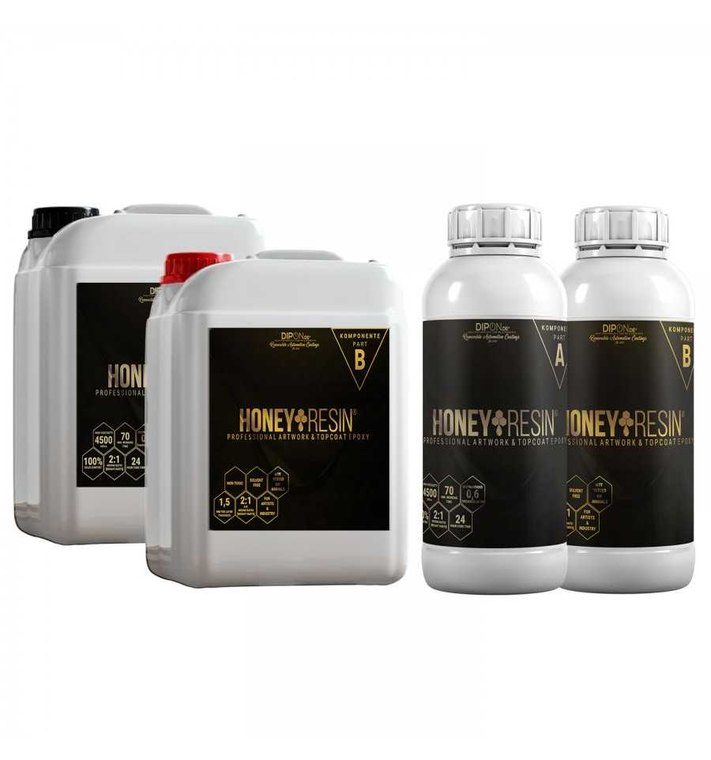 HoneyResinTopCoat and GEODE, thin layers · very thickView ›
Need a fresh supply?
Quality casting epoxy resins for river tables, jewelry and decorations, all in stock in one place.
Browse casting resinsRelated products and categories
- Resin systems: LuminaCast
- Buy: casting epoxy resins
Frequently asked questions (FAQ)
Can I heat epoxy in the microwave?
Definitely not. A microwave can overheat epoxy unevenly, damage the bottle or even cause a premature exothermic reaction. Use only a hot water bath or slow warming at room temperature.
Does warming epoxy in the sun, e.g. in a black bag, help?
No. This „home trick“ often leads to overheating or incomplete dissolving. Sunlight is not controllable and can permanently damage the epoxy. Avoid direct sun and extreme temperatures.
Can I use epoxy even if it's cloudy or has white haze?
Warm it before you start working. Cloudiness or white haze is a result of crystallization at low temperatures. The solution is slow warming in a water bath (about 50 °C). Never mix crystallized epoxy without regenerating it first.
Is it a problem if I breathe on a fresh casting?
Yes. Human breath contains moisture that can condense on the resin surface and cause a matte film (amine blush). Work in a dry environment and don't lean over the casting.
Is it enough to store epoxy somewhere in the workshop or garage?
The ideal is a dry, tempered environment. Low temperature and humidity can cause crystallization, degradation of the hardener or leaking bottles. Store the components at 18–22 °C, in airtight, upright storage.