
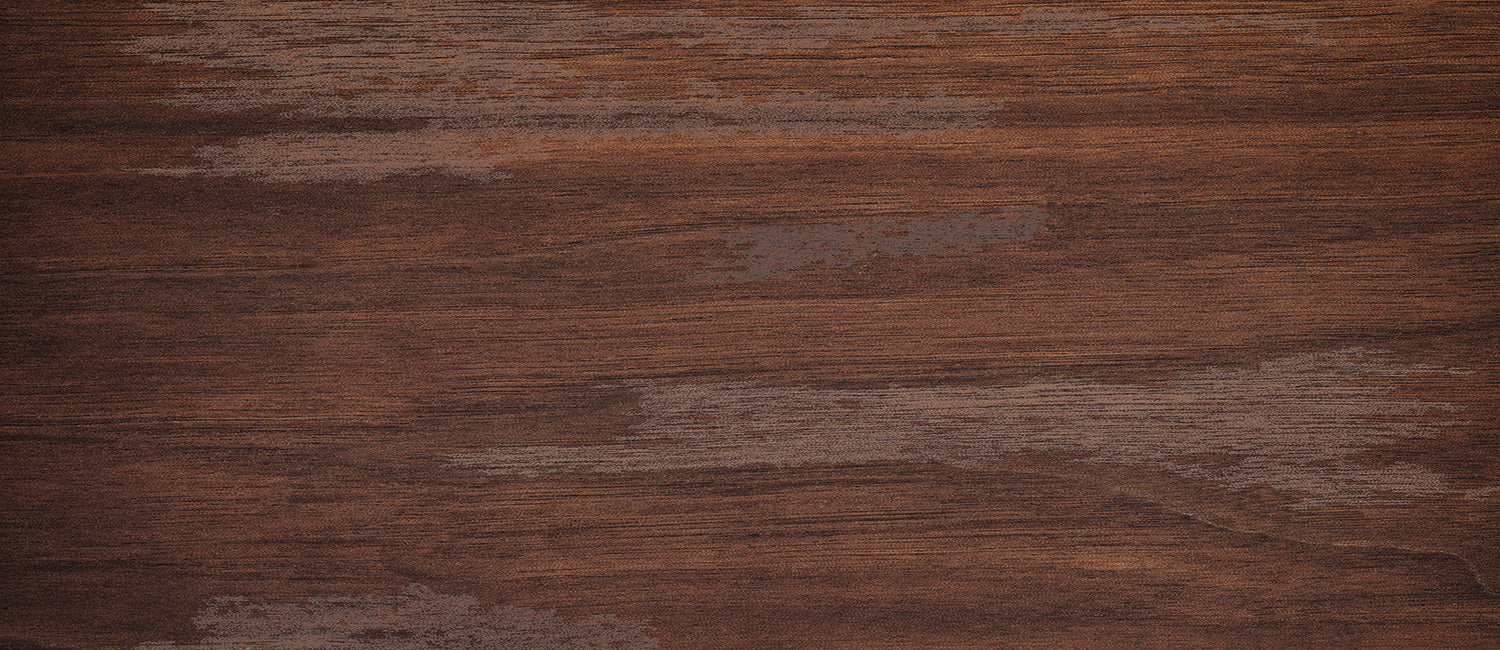
Blotchy finish after oiling?
You've oiled the wood and the surface is uneven — matte in places, white or glossy in others? You're not alone. This effect is called a blotchy finish and it almost always has a clear cause you can remove.
A blotchy finish appears when the surface doesn't cure evenly. Below is a quick diagnosis, the five most common causes — and for each, how to prevent it and how to fix it.
Quick diagnosis
| Symptom | Most common cause | Fix |
|---|---|---|
| White spots / raised patches | wax excess, too little buffing | re-sand with an 800 pad + buff |
| Sticky surface | incompatible finishes / too much oil | remove excess, let it cure, test on a sample |
| Uneven color | sanding too coarse/fine, careless application | re-sand 220–320, apply evenly |
| "Maps" / water rings | not enough buffing, moisture | wipe off excess, watch wood moisture |
| Won't cure, stays wet | too much thinner / wet wood | less thinner, dry the wood properly |
01Excess finish and too little buffing most common

When you apply too much oil or wax and don't buff the surface evenly, the excess cures and creates white spots or raised patches. Most common with wax finishes.
How to fix it:
- gently re-sand the whole surface with a non-abrasive 800 pad until it looks uniform,
- buff with a non-abrasive polishing pad to remove any wax residue,
- repeat until the surface stays uniform for a week.
02Poor surface prep
Sanding too fine or too coarse causes trouble with the first coat. The ideal is a surface sanded to 220–320. Too coarse → the wood soaks up too much oil and needs more coats for a uniform look. Too fine → the finish sits on the surface and the wood stays unprotected.
03Incompatible finishes
Combining incompatible finishes — e.g. an oil first coat and then a water-based stain second — leads to an uneven result. Don't mix oil and water-based finishes. If you reach for a pure natural oil like Cutting Board Oil, Furniture Finish or Tung Oil, which polymerize evenly, you'll cut the risk dramatically.
 Cutting Board Oilevenly penetrating oil for boards · food-safeBuy ›
  Furniture Finishfurniture oil · matte “Danish Oil” lookBuy ›
  Wood Waxwax topcoat · easy buffing without spotsBuy ›
04Too much thinner
An excessive amount of thinner in the mix makes it evaporate more in some places than others, and the surface is uneven. Either don't use thinner at all, or no more than 25% in the mix with the finish. Walrus Oil natural oils are solvent-free, so this problem disappears.
05High wood moisture
Excess moisture prevents even polymerization — or stops it entirely. Before you start, make sure the wood is dried to 10% moisture or less (kiln/air dried). A wood moisture meter.
- dry the wood to ≤ 10% and clear away glue and dirt,
- apply the first coat on a surface sanded to 220–320,
- always remove excess with thorough buffing (especially with waxes),
- don't mix different finishes and thinners (max 25% thinner),
- when in doubt, test on a sample.
The 5 most common oiling mistakes
- Too much oil or wax at once — the excess cures as blotches. Apply thin coats and buff.
- Too little buffing — especially with wax. Always wipe off excess to a uniform surface.
- Wet or poorly prepped wood — oil at ≤ 10% moisture and sand the surface to 220–320.
- Mixing incompatible finishes — don't combine oil and water-based; test on a sample.
- Too little cure time — don't expose it to water or sun before the finish polymerizes.
Reach for a finish that dries evenly
Walrus Oil natural oils and waxes penetrate the wood and polymerize evenly — without needless blotches.
Browse Walrus Oil oils and waxesRelated products and categories
- Oils: Cutting Board Oil, Furniture Finish, Tung Oil, Linseed Oil
- Wax: Wood Wax
- All: Walrus Oil wood finishing
Related guides
Frequently asked questions (FAQ)
What's the most common cause of a blotchy surface?
Clearly excess finish and too little buffing — especially with waxes. The excess cures as white spots or raised patches. The fix is to gently re-sand and buff thoroughly.
Why did the oil turn white on my wood?
White spots are most often dried excess (especially wax) or water rings from insufficient buffing. Re-sand with an 800 pad and buff.
Can a blotchy surface be fixed, or do I have to start over?
Usually it can be fixed. Re-sand the surface with a non-abrasive 800 pad, buff and repeat until it stays uniform. Only in tougher cases do you need to sand it back and reapply.
How dry does the wood need to be before oiling?
No more than 10 %. Higher moisture prevents even polymerization and is a common cause of blotches. Use a wood moisture meter.
Can I mix an oil and a water-based finish?
We don't recommend it — they tend to be incompatible and the result is uneven or sticky. Always test on a sample board before combining.