

How to Choose CA Glue: A Guide for Wood, Stone and Models
Choose CA glue by the width of the joint: thin glue wicks into hairline cracks and tight-fitting joints, medium handles both, and thick fills gaps up to 0.5 mm without running. An accelerator helps when you need the bond instantly or you are gluing a porous material.
How do you choose a CA glue that holds the first time? This guide walks through three decisions in the order you make them at the workbench – and for wood repairs it adds color, so the joint blends into the grain.
01How to choose CA glue: three questions that decide
Look at the joint first, not at the glue. Thickness decides whether the glue gets into the joint or stays in it.
- How wide is the gap? Parts fit tightly → thin. A gap you can see with the naked eye → thick.
- What are you gluing? Porous wood and ceramics soak up glue, ordinary CA glue dissolves foam, and polyethylene and polypropylene do not bond at all.
- How much time do you need? The fastest thin glue grabs in a few seconds; slower and thicker glues give you half a minute to align the parts.
| At the workbench | Glue · thickness · color |
|---|---|
| hairline crack, tight-fitting joint | EM-02 Super Fast Thin thin · 2–3 cPs · clear |
| glossy CA finish on the lathe | Original Super Thin, EM-40 Heavy Thin thin · 2–40 cPs · clear |
| foam, balsa, work where odor is a problem | NO-05 Odorless thin · 4–7 cPs · clear |
| everyday repair, small gaps, not sure | EM-150 Medium medium · 150 cPs · clear |
| knot, void, 0.25–0.5 mm gap, sloped or vertical surface | EM-2000 Gap-Filler thick · 2,000 cPs · clear |
| fine crack in dark wood | KE-150 Black Medium medium · 150 cPs · black |
| knot or void in dark wood, contrast fill | KBL-500 Black Medium-Thick medium-thick · 500 cPs · black |
| crack in light wood (oak, maple, cherry) | BR-150 Light Brown medium · 150 cPs · light brown |
| knot and crack in walnut | BR-500 Dark Brown medium-thick · 500 cPs · dark brown |
| rubber, leather, impact and vibration | KEG-500 Flexible medium-thick · 500 cPs · clear, flexible |
All glues sorted from the thinnest to the thickest are in the thickness overview in one place.
02Thickness made simple: water, oil, syrup, honey
Thickness (viscosity) is given in centipoise – cPs. Water is about 1, honey around 2,000. The lower the number, the more the glue flows and wicks into seams; the higher it is, the more it holds its shape and fills.
What is the difference between thin and thick CA glue?
Thin glue (2–40 cPs) draws itself into a tight seam by capillary action – you apply it to parts that are already fitted together or into a crack, not into a gap. It is also used to stabilize fragile wood and stone. Medium (150 cPs) flows into gaps up to 0.15 mm wide and fills small gaps at the same time. Medium-thick (500 cPs, like syrup) fills more than it flows. Thick (2,000 cPs) fills a 0.25–0.5 mm gap and does not run even off a sloped or vertical surface.
Thickness does not tell the whole story about speed, though. The fastest is the thin EM-02 (2–5 seconds), medium EM-150 grabs in 10–15 seconds and thick EM-2000 in 20–30 seconds. Thin Original Super Thin and EM-40 also take 20–30 seconds – on purpose, so there is time to spread them when finishing.
If you are not sure, start with medium
Medium thickness does a bit of everything – it flows in and it fills. Add thin and thick later, once you know you need them:
 EM-150 Mediumall-rounder for most jobs · 150 cPs · sets in 10–15 sView ›
  EM-02 Super Fast Thincracks, tight joints, stabilizing · 2–3 cPs · 2–5 sView ›
 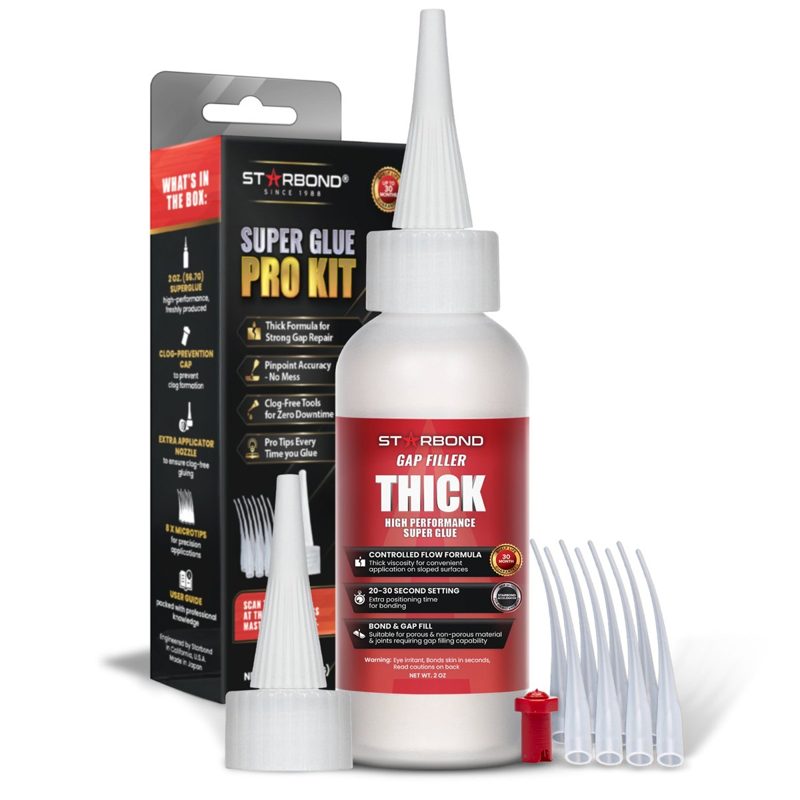 EM-2000 Gap-Fillerknots, gaps, sloped surfaces · 2,000 cPs · 20–30 sView ›
The glues come as a Pro Kit: with the bottle you get micro-tips for precise dosing, a cap with a pin that keeps the nozzle from clogging, and a spare nozzle.
03Which CA glue for which material
CA glue bonds wood, metal, ceramics, stone, rubber, leather, laminate and most plastics – the difference is in the thickness and in what to watch out for.
| Material | What to choose | Watch out for |
|---|---|---|
| Wood | thin for finishing and stabilizing, medium for joints, thick for knots; colored to match the species | porous wood soaks up glue |
| Stone, minerals, fossils | thin for stabilizing cracks, medium for bonding | — |
| Metal | medium or thick | lightly roughen a smooth surface |
| Plastics and 3D prints | thin for precisely fitted parts, thick for loose ones | polyethylene and polypropylene do not bond |
| Ceramics | medium or thick | unglazed ceramics soak up glue |
| Foam and balsa | NO-05 – foam-safe | ordinary CA glue dissolves foam |
| Rubber, leather | flexible KEG-500 | an ordinary bond cracks when flexed |
Which CA glue for wood?
Thin for consolidating soft or punky wood and for hairline cracks, medium for gluing parts and small repairs, thick for knots, voids and loose joints. If the repair should disappear into the grain, choose a colored glue to match the species (chapter 05).
Which thin glue for a CA finish on the lathe?
Three clear thin glues suit a glossy protective coat on turned pens, bowls and handles. EM-02 sets the fastest, so the coats build up the fastest. Original Super Thin gives you 20–30 seconds to spread it and has a low tendency to bloom. EM-40 is slightly thicker (40 cPs), spreads less and leaves fewer stains around the joint on light wood.
 Original Super ThinCA finish, stabilizing · 2–5 cPs · 20–30 s to spreadView ›
  EM-40 Heavy Thinfinish, cracks, inlays · 40 cPs · clear bond without hazeView ›
For stone, minerals and fossils
Thin glue soaks into cracked stone and consolidates it; it is also used in fossil preparation and for inlays made with metallic powders. Medium is enough to glue a crystal to wood – it stays clear after curing.
For metal and ceramics
Medium or thick glue. Lightly roughen smooth metal before gluing; unglazed ceramics soak up part of the glue.
For plastics and 3D prints
Thin glue bonds PLA, ABS, PETG and polycarbonate prints as long as the parts fit precisely. Loose fits and layers with gaps are better filled with thick glue. With a new plastic, always test the bond in a hidden spot.
Does CA glue bond polystyrene?
Ordinary CA glue dissolves foam. For foam models, balsa structures and work where a strong odor is a problem, NO-05 Odorless was designed – a very thin glue made from a different type of cyanoacrylate (2-methoxyethyl), foam-safe and low in odor. You still need to ventilate.
 NO-05 Odorless
foam-safe · low odor · 4–7 cPs›
What CA glue does not work on
Polyethylene (PE), polypropylene (PP) and silicone. These materials have such low surface energy that the glue cannot grip them – you will recognize them by their greasy, waxy surface (jerry cans, food containers, silicone molds).
04What an accelerator does and why CA glue blooms
An accelerator (also called an activator) is a solvent-based product that triggers the reaction of CA glue instantly. Without it, the glue cures with moisture from the air – quickly in a thin layer, much more slowly in a larger amount or in a gap.
- instant fixing – the parts hold the moment you put them together; handy for batch gluing,
- stops soaking in – on balsa, softwood and ceramics it stops thin glue before it disappears into the material,
- colored fills – black KE-150 and KBL-500 take 1–2 minutes to set without an accelerator and about 20 seconds with one; for filling knots and cracks the maker of the colored glues recommends it,
- primer for difficult surfaces – applied to one side of the joint before gluing, or sprayed over the glue once it is applied.
Why CA glue blooms and how to prevent it
The white haze around a joint (blooming) forms mainly with too much glue and slow curing: vapors escape from a large drop and settle on the surrounding surface as a white film. The best prevention is a small drop and parts pressed tightly together. A thick layer of glue in the middle also does not cure all the way through, and the joint is weaker.
05Black, brown and flexible CA glues
Clear glue in dark walnut or wenge stays visible as a light line. Colored CA glues hide the repair – choose them by the color of the wood and by whether you are filling a crack or a knot.
| Wood | Glue |
|---|---|
| oak, maple, cherry | BR-150 Light Brown cracks · 150 cPs · amber tone |
| walnut, medium-dark species | BR-500 Dark Brown knots and cracks · 500 cPs · coffee tone |
| wenge, ebony, spalted and burl wood, contrast detail in light wood | KE-150 Black Medium fine cracks · 150 cPs KBL-500 Black Medium-Thick knots and voids · 500 cPs |

KE-150 Black Medium flows into fine cracks in dark wood, KBL-500 Black Medium-Thick fills knots and voids up to 0.2 mm. For light wood there is BR-150 Light Brown, for walnut BR-500 Dark Brown.
- the black glues are rubber-toughened – they handle impact and vibration better, but set more slowly, in 1–2 minutes,
- the brown ones set in 20–30 seconds; build up a larger fill in layers,
- after curing, sand the repair flush and polish it; black KE-150 takes stain, oil and lacquer,
- also handy for small repairs when sanding epoxy tables and boards.
Flexible glue for rubber, leather and vibration
Ordinary CA glue is hard and brittle once cured – it cracks on impact or when flexed. KEG-500 Flexible (500 cPs, clear) is rubber-toughened and handles impact and vibration better. Use it on rubber, leather, metal-to-rubber joints, shoe soles, rubber tool grips and arrows. It gives you 20–30 seconds to align the parts.
06CA glue or epoxy? When CA glue is not enough
CA glue is the master of thin joints. As soon as the gap is wider than half a millimeter, the joint carries a load or you need minutes to assemble, reach for a two-part epoxy.
For a missing piece of material there is epoxy putty – you model it and sand it once cured.
 5-Minute Epoxy Kitfast two-part adhesive · workshop repairsView ›
  30-Minute Toughened Epoxytough, absorbs shocks · 30–35 min working timeView ›
  Wood Epoxy Puttywood putty · replaces a missing pieceView ›
 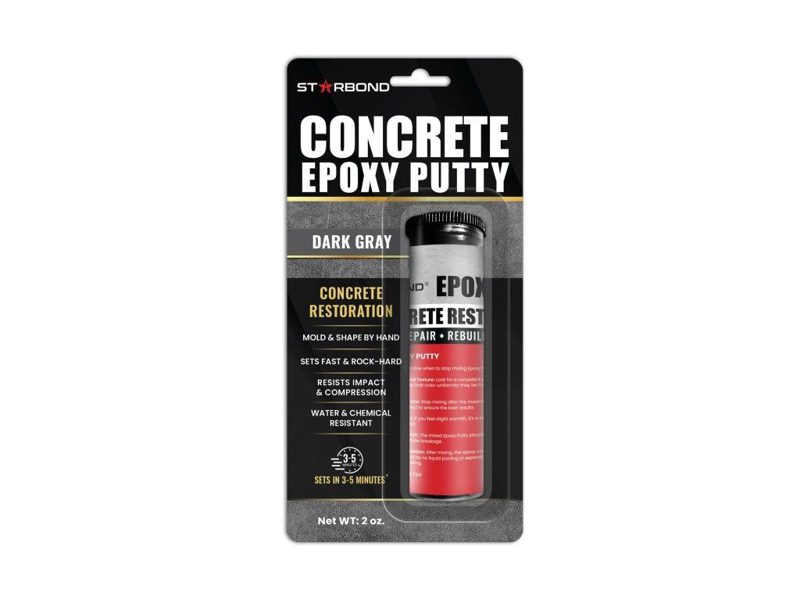 Concrete Epoxy Puttyputty for concrete, masonry · stoneView ›
The full range of two-part adhesives and putties is in the epoxy adhesives category.
07Make it last: storage and safe work
CA glue ages from the same moisture that cures it – on a warm windowsill with the nozzle open it thickens within a few weeks.
- Store it cold – ideally in a fridge at 4.5 °C or below, tightly closed. For most glues the manufacturer then states a shelf life of 30 months.
- Let the bottle warm up before work to room temperature, so moisture does not condense inside.
- Dose with a micro-tip – the drop will be exactly as big as you need, and the nozzle will not clog.
- After work, push the pin from the cap into the nozzle and close the bottle right away.
CA glue bonds skin and eyes instantly, and its vapors irritate the eyes and airways. Work in a well-ventilated area, protect your eyes and keep the bottle out of the reach of children. Low-odor glues release vapors too – always ventilate. Details are in the safety data sheet for each product.
- tight joint and crack = thin, gap up to 0.5 mm = thick, not sure = medium,
- for a CA finish, thin with time to spread; for foam and balsa NO-05; CA glue does not hold on PE, PP and silicone,
- light wood BR-150, walnut BR-500, dark wood and contrast black; rubber and vibration call for KEG-500,
- white haze = too much glue; dose a small drop and press the parts tightly together,
- wider gaps and load-bearing joints belong to epoxy; store the glue cold.
Find your CA glue
Clear, black, brown and flexible – from glue as thin as water to as thick as honey, in stock.
Browse CA gluesRelated products and categories
- All-rounder: EM-150 Medium · Thin: EM-02 · Thick: EM-2000
- CA finish: Original Super Thin, EM-40 · Foam and low odor: NO-05
- Black: KE-150, KBL-500 · Brown: BR-150, BR-500 · Flexible: KEG-500
- Clear range: transparent CA glues
Related guides
- Starbond adhesives overview
- How to make an epoxy resin table – repairing knots with CA glue before pouring
Frequently asked questions about CA glue
What is the difference between super glue and CA glue?
None. Super glue, CA glue and instant glue all mean the same thing – a cyanoacrylate adhesive that cures by reacting with moisture in the air within a few seconds. They differ in thickness, speed, color and whether they are foam-safe.
Which CA glue is the most versatile?
A medium thickness around 150 cPs, for example EM-150 Medium. It flows into gaps up to 0.15 mm wide and fills small gaps, sets in 10–15 seconds and bonds wood, metal, stone, ceramics and most plastics.
Why does CA glue bloom and how do you prevent it?
The white haze forms mainly with too much glue and slow curing – vapors from a large drop settle on the surrounding surface. Dose a small drop and press the parts tightly together. For light wood and a CA finish, choose low-blooming formulas, for example Original Super Thin or EM-40.
Does CA glue bond polystyrene?
Ordinary CA glue dissolves foam. For foam models and balsa use a foam-safe glue, for example the thin, low-odor NO-05 Odorless, and do not use a solvent-based accelerator on foam.
How long does an opened CA glue last?
For most glues the manufacturer states a shelf life of 30 months when stored cold (4.5 °C or less) in a tightly closed bottle. In a warm place and with the nozzle open, the glue thickens much sooner – so after work, push the pin into the nozzle and put the bottle back in the fridge.
How do you remove CA glue?
A dedicated CA glue debonder dissolves it from skin and from a failed joint. Never pull a bond apart by force, especially with glued fingers.